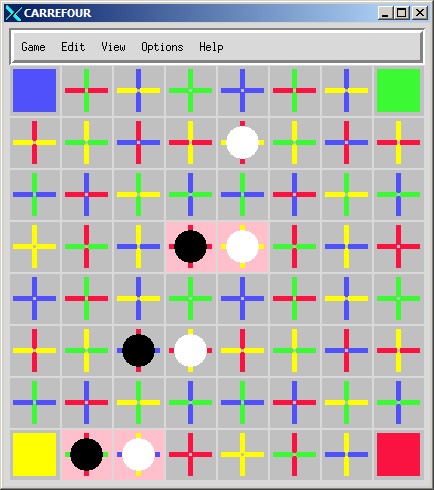
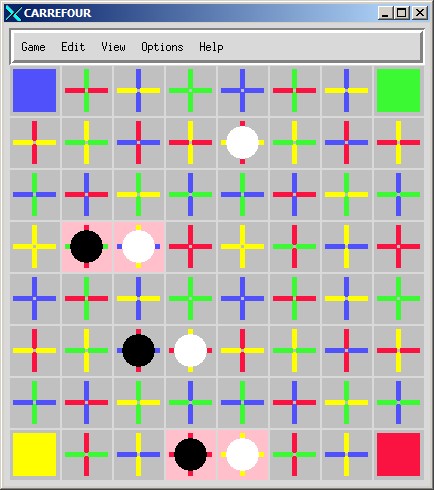
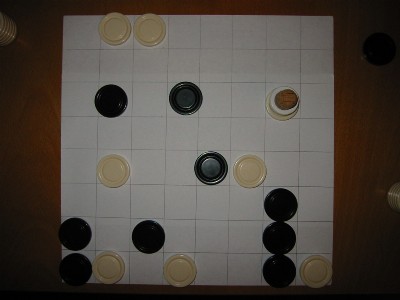
1  8 x 8 square board
64 Each black and white pieces
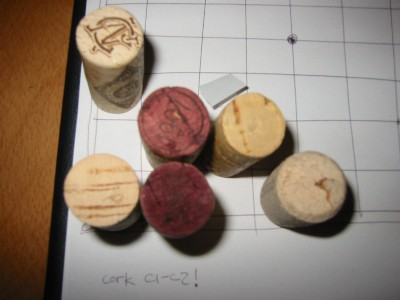
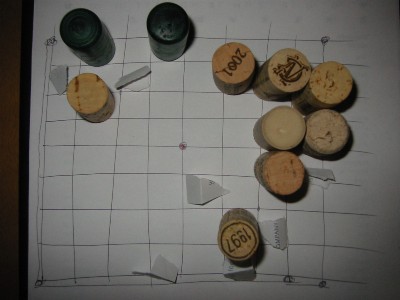
2  Rectangular markers approximately 1 x 1/2 squares in size, able to
   rest stably on either one piece or two adjacent pieces.

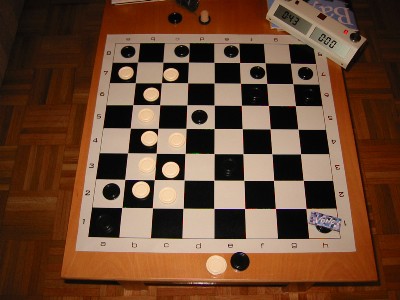
An othello set is sufficient for the the board and pieces, although
play on a tournament chess board using GIPF pieces is easier and safer.
Matchboxes are a perfect size for the markers.
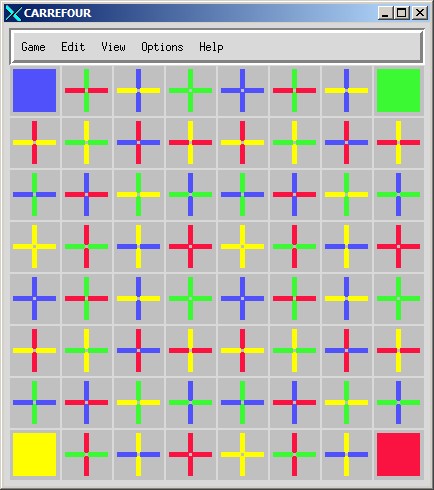
The players sit at a 90 degree angle to one another, one on the west
side of the board (facing east) and one on the south side of the board
(facing north).  These will henceforth be referred to as "E-W" and "N-S".
Note that the perspective results in the ranks of one player being the
files of the other player, and vice versa.  The board begins empty.
N-S begins and turns alternate.  On each turn, a player has two options:

1) Drop a piece.  A piece of either color may be taken from the reserve
   and placed on any vacant square in the player's first rank (i.e. the
   western edge for E-W, and the southern edge for N-S).

2) Move a piece.  The player may move any piece on the board, regardless
   of which player originally placed it, subject to the following rules:
   a) General movement:  Pieces move as qiangxi horses, i.e. as chess
      knights that can be blocked by another piece directly in front
      of its intended line of movement.  The square it moves to must
      be vacant.
   b) Color restriction:  Black pieces ("shadow steeds") may only move
      in the four directions beginning with a vertical move (i.e. up
      or down two, over one), while white pieces ("cloud riders") may
      only move in the four directions beginning with a horizontal move
      (i.e. left or right two, over one).  Note that the differing
      perspectives of E-W and N-S afford them different moves for
      each piece!
   c) Carrying:  A moving piece may "carry" with it any piece orthogonally
      adjacent to its line of movement -- so long as that piece is also
      moving to a vacant square and is not blocked in the xiangqi sense.
      The carried piece makes the exact same move as the moving piece,
      so it remains next to that piece on the same side.  E.g., a black
      piece with another piece (of either color) to its left or right may
      make any of its usual four moves, and carry the other piece with it.
      Similarly, a white piece carries a piece above or below it.
      A "double-carry" taking one piece on each side of the moving piece
      is also allowed.
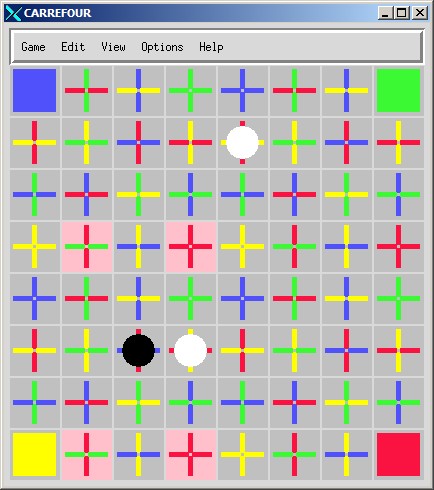
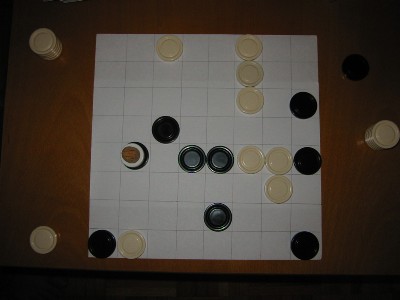
   d) The Hot Piece Rule:  A piece which has just been dropped, moved,
      or carried by the other player is a "hot piece" that cannot be
      moved.  This should be indicated by placing a marker on top of
      the one, two, or three affected pieces (both markers are needed
      for a double-carry).  This rule allows one player to continue
      moving one piece or set of adjacent pieces until he chooses to
      relinquish control.
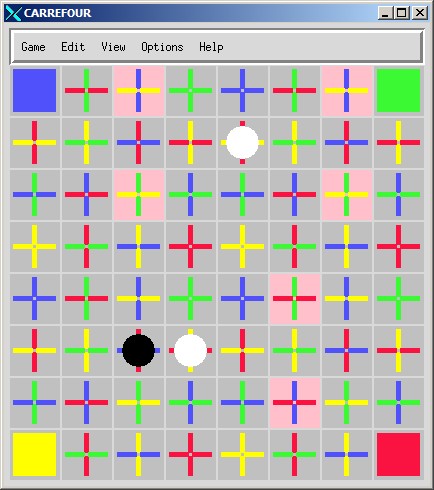
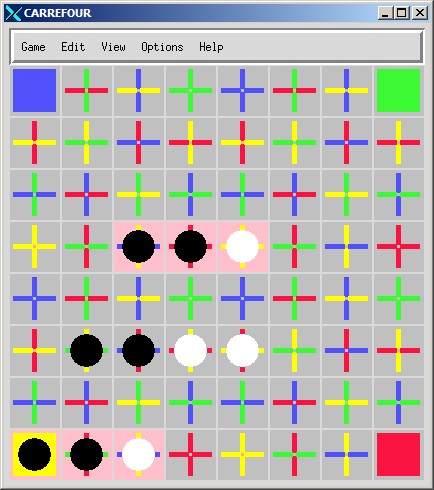
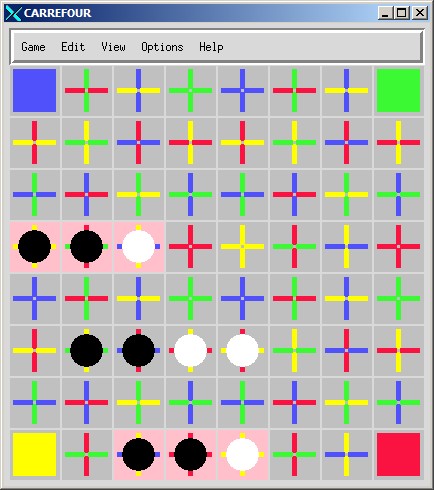
In the unlikely event that a player has no legal moves, he passes and
there is no hot piece in the following turn.
To occupy all four corners of the board.  The player whose turn ends
with all four corners occupied wins the game.
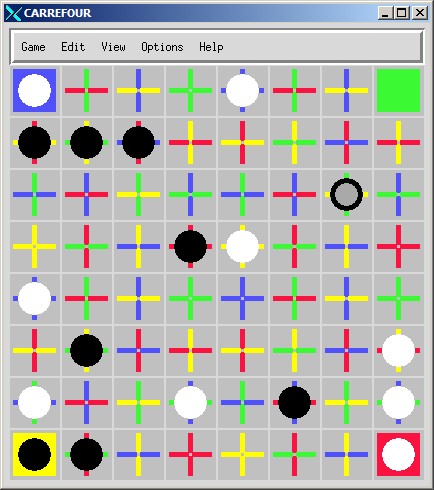
The game lends itself well to the use of timers, which aid development
at the appropriate times in the game.  Recommended settings include 15
minute 10 second Bronstein for standard play, and 2 minute 5 seconds Fischer
for blitz.
Corner Strategy.  The most basic note on strategy revolves around
the four corners, each of which commands its own unique strategy set.
Because a player can always drop into the two corners in his first rank,
the primary thrust of the game is to occupy those in his last rank,
particularly the one his opponent can drop into.  Conversely, one is
often defending his own corner (the one only he can drop into), since it
is to his advantage to keep it free.  Thus, the four corners are often
referred to as "home", "enemy", "near", and "far".  Even the near corner,
despite relatively less interesting action, sometimes yields a critical
"near corner tempo" that releases the hot piece at a critical juncture.

Lock Structure.  The next major concept is that an occupied corner
with no other pieces around it can easily be dislodged by the opposing
player; thus, many supporting pieces must be used to keep the piece there.
Each piece that must be moved before the corner piece is termed a "lock",
and can be created by either xiangqi blocks or nonvacancy blocks.
A chain of locks, together with any "secondary locks" that can fill
in for removed locks, is called a "lock structure"; one's opponent
must "unravel" each lock in the structure to free the corner piece.
Usually, at least one "deep" lock structure is required to win the game.
Common lock structures include phalanxes (lines of same-colored pieces
which, from the opposing perspective, block one another's movement)
along either the edge or gutter (second file or rank), and tangles, which
utilize great masses of pieces to confuse and generally block movement.
"Floating phalanxes" in the middle of the board can also be beneficial,
due to the tempos required for one's opponent to unravel them.

Game Development.  The game naturally has three phases:
Opening:  Building mass.  Characterized by many drops and double carries.
  Some struggle for position, but without locks even home corner
  occupations are often disregarded.
Middlegame:  Building structure.  Heralded by the development of the far
  corner, often in a solid drive following a credible siege on an
  enemy corner.  When it instead happens using a spare tempo and spare
  support pieces, the transition appears more fluid, but still leads
  toward an endgame.  The end of developmental offensive drops.
Endgame:  Final attack.  Begins when one player establishes a credible
  threat to win the game, and makes a move to lock the enemy corner
  (or less commonly, the far corner).  Drops in the near corner are
  a sure sign of an endgame, whether the defensive player previously
  recognized it or not.  However, due to the common objective, entering
  this phase also helps one's opponent, and leads to a very delicate
  balance of power.  As sufficient lock structures are often difficult
  for even the offensive player to unravel, final attacks usually lead
  to victory -- whether by the original attacker or not.
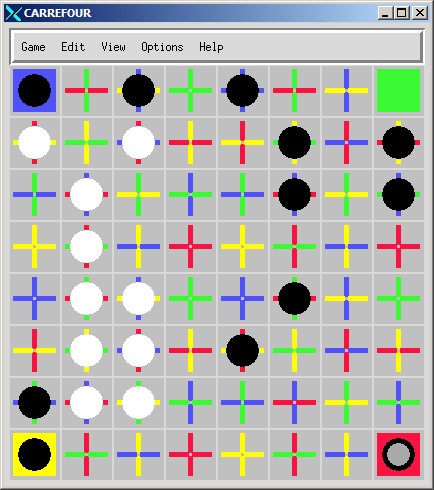
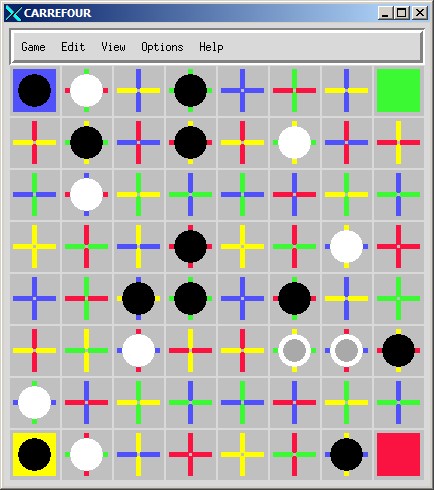
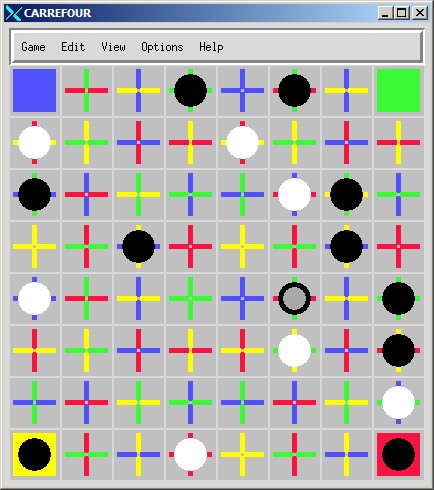
Carrefour was created by Eric Yeh in 2003, for the sole purpose of
competing in the prestigious Game Design Competition sponsored by Abstract
Games Magazine and About Board Games.  The theme of the 2004 competition
was shared pieces: all entries were required to use only pieces that both
players had the ability to move.
This page has been accessed times.